HOOVES OF GOLD: In Berlin
Written by Nina Moog.
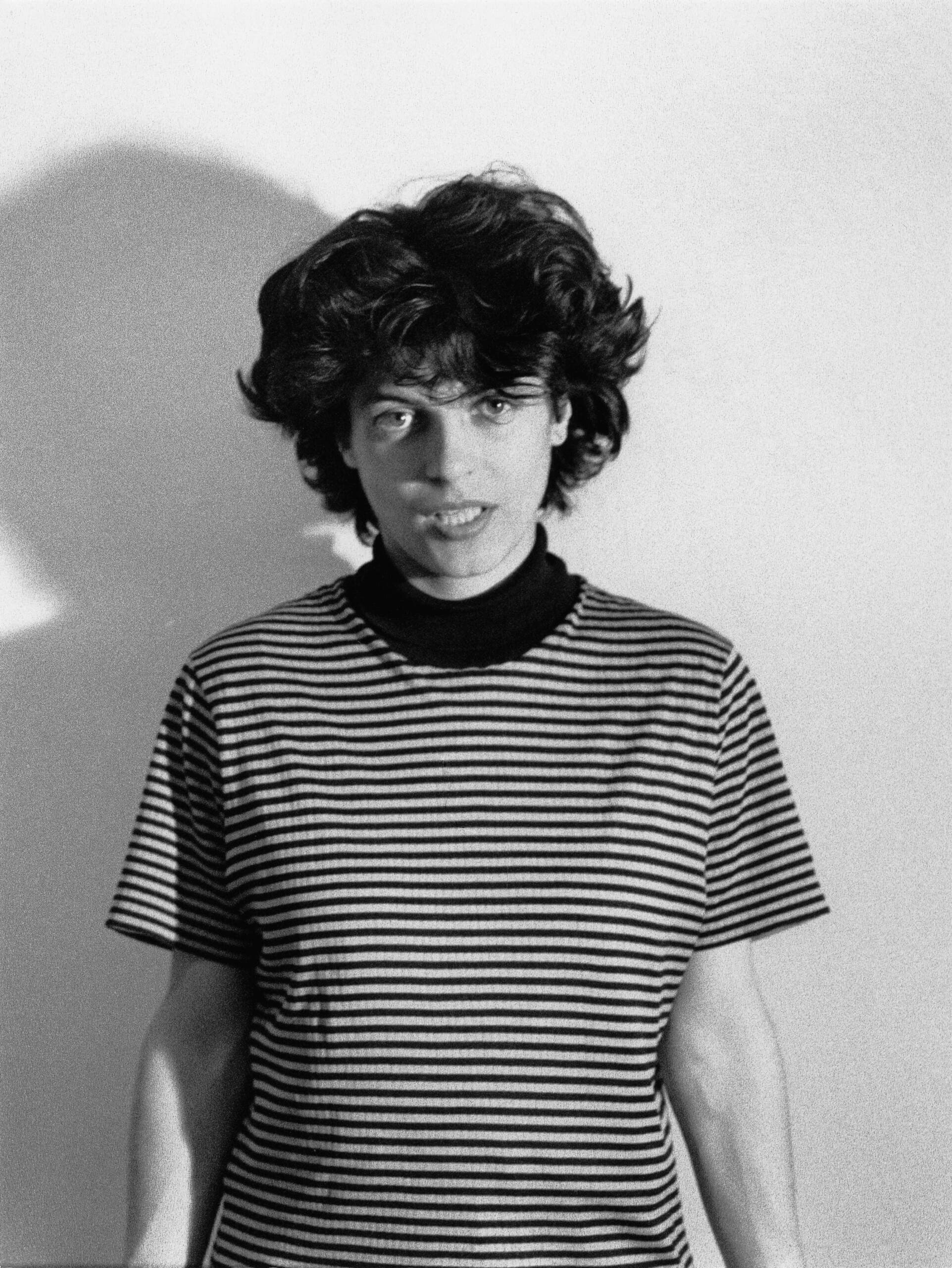
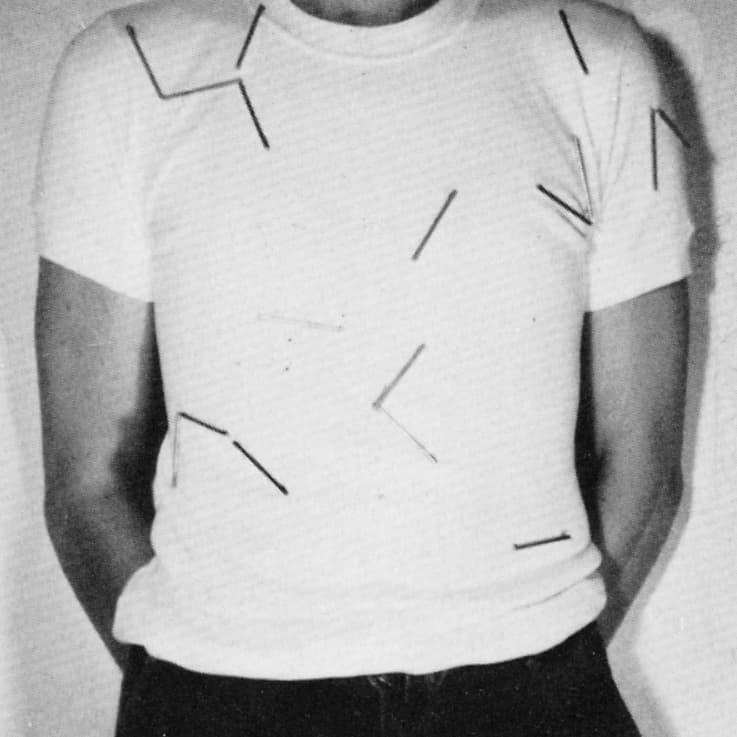
Gabi and Günther Förg were good friends, who met while studying together at the Akadamie der Bildenden Künste in Munich. Günther climbed the stairs to the goldsmith workshop, and asked Gabi to stand against the wall. Afterwards, Gabi was displeased. She had hoped that he would create a ‘beautiful portrait of her as a chanson’ with a far more glamorous set up. ‘He released the shutter three times, and that was it. He could be a little brisk!’
It’s a warm June afternoon, and the trailblazing jeweler Gabi Dziuba is sitting in the sunshine, drinking a glass of Cattarato in front of Berlin’s historic Volksbühne. A server brings us a second glass, informing us that our wine is on the house. Later on, a friend of Gabi’s stops at our table, thanking her for a recent gift of flowers. Gabi may have spent most of her adult life in Munich, but I get the impression that she reigns over this particular street corner. From our table, Gabi’s home and studio are within our eye line: this square is her public living room.
A few blocks away, the words Dziuba Jewels are emblazoned above the entrance to Gabi’s studio and showroom, underlined by a glowing, fluorescent tube. On an inner door frame, scraps of paper hang face down, waiting to be taped to the glass door in case she needs to run out. ´Getting my glasses!’ one note exclaims, followed by Gabi’s phone number. She tells me that these remind her of the away messages Holly Golightly has in Breakfast at Tiffany’s. We enter the street facing showroom, designed by the Austrian artist Heimo Zobernig. Across the room, a dark Hans-Jörg Meyer painting hangs mid-air by way of a linked metal chain. Duck behind it, and Gabi’s jewelry work bench and desk are revealed.
We flip through a catalogue, and pause on a whitegold necklace she designed for a DeBeers competition in 1976, its diamonds embedded towards the end of a poetic squiggle. Gabi designed the piece while studying in Pforzheim, where she attended the Fachhochschule für Gestaltung under Reinhold Reiling from 1972-78. One of her classmates was the jeweler Manfred Bischoff, and the two of them shared a beautiful, Altbau apartment. In love, Gabi painted the entire kitchen gold. Neck craned skywards for days, she transformed the ceiling into a fantasy landscape where Wiener Schnitzel danced beside grapes and farmyard chickens. At one point, the duo spent three months in London, where they stumbled upon The Rocky Horror Picture Show. Despite their overlapping aesthetic worlds, Gabi and Manfred’s tastes in music and art differed. She loved ACDC, The Sex Pistols, Violent Femmes, while Manfred found some of these influences low-brow. ‘He liked finer things’ she tells me. ‘His tastes were a little more sophisticated than mine.’ Back then, one of Gabi’s favourite songs was Ian Dury’s Sex & Drugs & Rock & Roll. She shows me a small sculptural piece Manfred made for her: a miniature Dury with ‘Sweet Gene Vincent’ spouting from his lips, words written through sweet metal twists.
After graduating Pforzheim, Gabi and Manfred hoped to study under Hermann Jünger at the Akademie Der Bildenden Künste in Munich. Early on, Gabi realized that a commercial jewelry path wasn’t in her future. She had interned at a commercial factory that made samples for mass production, where a goldsmith asked her to make some small cufflinks. ‘I thought to myself, I can’t make such tiny cufflinks. I don’t know how do that at all. So I just made them much, much bigger. (The goldsmith almost fell off his chair when he saw them.) During her admissions interview, Jünger asked Gabi: ‘What will you do if I accept Manfred, and not you?’ Within the year, however, they were both studying in Munich together.
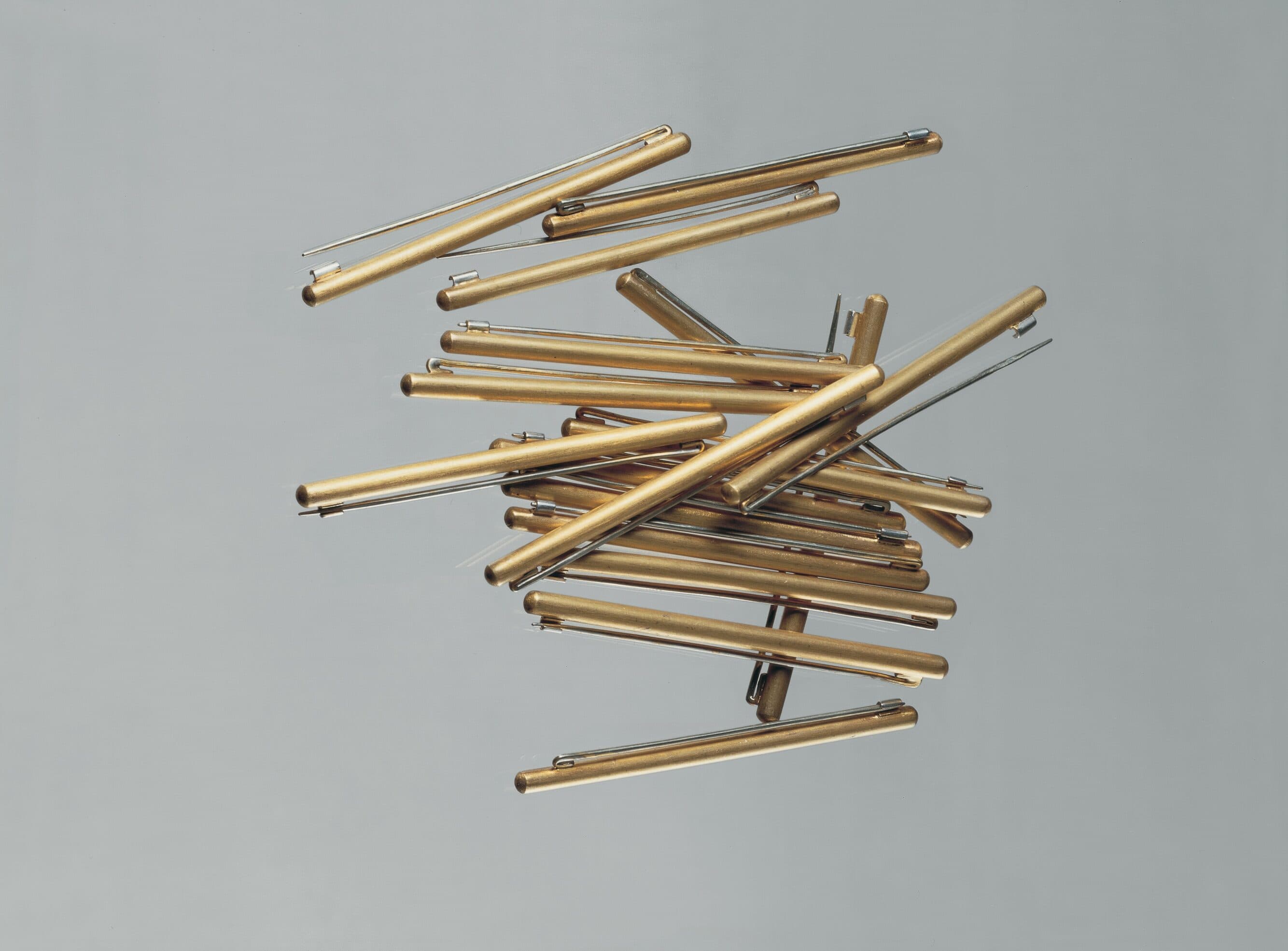
As an instructor, Jünger emphasized the importance of materials and craftsmanship. Back then, Gabi preferred to work with silver or metal alternatives, like wood. She pulls out a three piece wooden brooch. (1981.) ‘In Munich, some of us were reclaiming seemingly worthless material,’ she explains. She painstakingly covered the wood, which originated from decorative moldings, in a striking yellow lacquer. ‘Gold was considered bourgeois,’ she tells me. ‘And it didn’t quite fit with the times.’ Despite this, Gabi also made a series of elegant, gold safety pins. She still wears one today, using it to pin together the top of her shirt. Gabi places the pin onto the flat surface of the table, and I see that it’s slightly bent, the result of repeated repairs. She tells me, full of humor, that easy access to gold is one of the few luxuries afforded to goldsmiths. (Privately, I reflect that meeting iconic goldsmiths mid-week is one of the few luxuries of freelance writing.) Originally, this pin was one of seven, and the one on the table is the remaining survivor. Lost or found, a golden safety pin emanates a simple and beautiful extravagance. “What did Truman Capote say?” Gabi reflects. ‘I may be a black sheep, but my hooves are made of gold.’ She pauses. ‘Or whatever.’
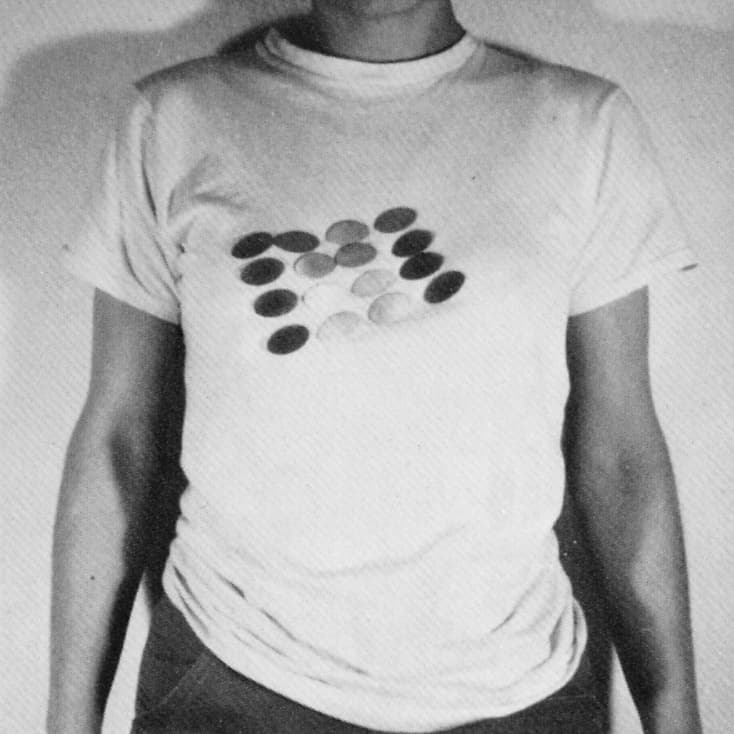
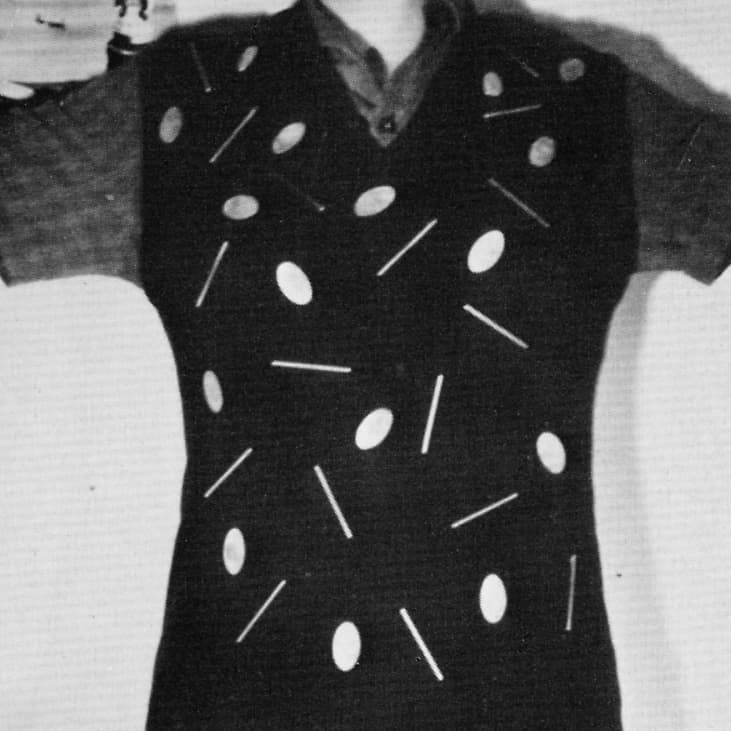
As we talk, Gabi’s preoccupation with the written word mediates our conversation. I’m impressed with how Gabi can quote lyrics and texts of unreal length from memory. She seems to find particular joy in the images that words can evoke. After attending an Andy Warhol exhibition in Stuttgart during the late 1970’s, she kept the catalogue. We flip through it together, delighting in Warhol’s verbal playfulness. ‘Look, here’s a Golden Birthday Shoe, or here, Shoe with Strawberries.’ Back then, she admired how Warhol’s hand-drawn shoes were covered in gold foil, appliqué style. It was decorative, and she hadn’t seen anything like it before. Warhol might have approved of Gabi’s 1979 Lenbachhaus show Körper-Zeichen, where she displayed polaroids of her work worn by friends. To take the photographs, Gabi placed a pile of gold-plated oval and tubular copper brooches on a table, instructing friends to wear them as they chose. She put her models up against a wall, and snapped. The artist Thomas Kammerl created a pattern, tucking the oval brooches under a sweater, Manfred Bischoff spelled out MY WAY, and Waltraut Reis arranged the ovals over her breast. At the time, Gabi wasn’t interested in making single brooches but focussed instead on the concept of multiples, and the free participation of the wearer.
Gabi’s aesthetic has always been influenced by music. After failing her final year of high school, an experience she credits as key to the development of her taste, her parents placed her under house arrest. While they may have been under the (false) illusion that she was studying, Gabi listened all day to the radio. “It’s also how I learned French,” she tells me, spouting off a few phrases as if in proof. In the mid 1980’s, Gabi was the singer in a six-person ‘psychedelic band’ called Die Schlüssel (The Keys in German.) They were ‘an answer to The Doors.’ Gabi leans back in her chair and recites from memory: “Eyelashes whisper on asphalt roads, his jeans are super tight! He drives a Ford Mustang, his pockets full of shit. Oh baby, baby! Take me with you! As she chants, I can’t stop smiling. It’s worth noting that my translation hardly does the lyrics justice. In their original German, some of these phrases rhyme in surprising and hilarious ways. Wearing a black miniskirt, Gabi would stand on stage and read directly from a typewritten page, often unable to make out the text because the clubs were so dark. On one recording, you can hear Gabi request the venue to turn on some lights.
Drawing inspiration from Beatles’ Apple Corps, Die Schlüssel created a so-called Schlüsselproduktion (Key Productions), making key-inspired costume jewellery. In a black and white photograph of the painter and Die Schlüssel founder Hans-Jörg Mayer, he sports round sunglasses and a rumpled, dark leather jacket. “He was the saxophone player,” Gabi says. “And he didn’t know how to play.” Fondly, she describes how he would blow his horn, his head growing progressively more red throughout the performance. Unassuming at first glance, studded to Hans-Jörg Mayer’s jacket are two small pins made by Gabi: a key and a silver skull (1985). The skull contains a little, devilish grin. Its smile reminds me of one of Gabi’s more recent pieces – a white-gold cufflink from 2018 which displays an expressive yet tearful face.
As a teenager, Gabi sent a heartfelt letter to Keith Richards. ‘Your earlier music was far better,’ she complained. Like most artists, Gabi is both maker and critic. Years ago, Gabi pulled all of the stereo cables from the wall sockets at the Munich club Why Not, bringing the music to a sudden halt. (The venue banned her for six months.) “The music was probably bad,” she explains. At the exhibitions of friends, Gabi has given the gift of honest feedback, something not always well received. Her fearlessness, however, has undoubtedly contributed to her artistic successes. During her studies, Jünger once suggested that she should consider a career in sculpture, and a newspaper review of Die Schlüssel described her as the worst singer in Germany. Ever confident in her interests, these moments have strengthened Gabi’s resolve.
In the past, I have been moved by the careless, confident vigor with which jewelers handle their work and attach it to the body. Each time I witness the laissez-faire, violent stabbing of metal through clothing, I feel a fresh jolt of surprise. As we discuss her work, Gabi handles her pieces this way, casually yet energetically piercing the fine material of her blouse. Demonstrating a three-piece brooch (1981) for me, she arranges its component parts on her chest. By the end of our conversation, her blouse holds several holes. I remark upon this, and Gabi tells me that years ago, someone once pointed out to her that her shirt was stained. ‘In response, I just cut the stain out of my shirt with scissors.’ Gabi tells me. “‘You see?,’ I told them. ‘Now the stain is gone.’”
You can follow and contact Gabi on Instagram @Dziubajewels. Gabi Dziuba has a forthcoming 2024 exhibition at the Schmuckmuseum Pforzheim. This interview was conducted in German, and quotes have been translated by the author.
ARTIST’S BIO
Nina Moog is a writer and director of photography currently based between Munich and Copenhagen. After a happenstance meeting with curator Kellie Riggs in Rome, she first contributed to Current Obsession magazine as a proof-reader in 2014. Since then, she’s climbed up the CO ladder to become this magazine’s roving Germany correspondent.